
Server-Side Tracking API Design: Build Reliable Event Pipelines
Learn how to design a reliable server-side tracking API with proper event payloads, validation, and retry logic. Build event pipelines that scale without data loss.
Introduction
Most SaaS teams treat their server-side tracking API as an afterthought, bolting event collection onto existing endpoints without thinking through contract design, payload validation, or what happens when a downstream consumer goes dark. The result is predictable: silent data loss, malformed events clogging warehouses, and engineers debugging phantom conversion drops at 2 AM. A well-designed backend event tracking layer is not just plumbing; it is the single most consequential piece of infrastructure for any team that depends on accurate behavioral data. The difference between a system that loses 5% of events under load and one that loses zero comes down to a handful of deliberate API design decisions that most teams skip. Applying strong data integrity principles helps prevent silent corruption in analytics pipelines.

Designing Your API Contract and Event Schema
The foundation of any server-side tracking API is the contract between producers (your application code) and consumers (your warehouse, analytics tools, or real-time systems). Getting this wrong poisons everything downstream, so the schema and endpoint design deserve more upfront investment than most teams give them.
Endpoint Structure and Payload Anatomy
The most resilient tracking APIs converge on a minimal surface area: a single POST endpoint (e.g., /v1/track) that accepts a JSON payload with a small set of required fields and a flexible properties object for event-specific data. Here is what a production-grade payload contract typically looks like, drawing from patterns used by Segment, PostHog, and Mixpanel.
event_name: A string following a strict noun_verb taxonomy (e.g., "order_completed"), enforced by an event taxonomy your team maintains centrally.
timestamp: ISO 8601 format, always UTC, always generated server-side to avoid client clock drift that silently corrupts time-series analysis.
user_id / anonymous_id: At least one must be present; reject the event at the API gateway if both are missing, because an unattributable event is worse than no event at all.
idempotency_key: A client-generated UUID attached to every request so your ingestion layer can deduplicate retries without double-counting conversions.
properties: A semi-structured object validated against a registered schema, where event-specific fields like revenue, plan_tier, or cart_items live.
Schema Enforcement That Actually Works
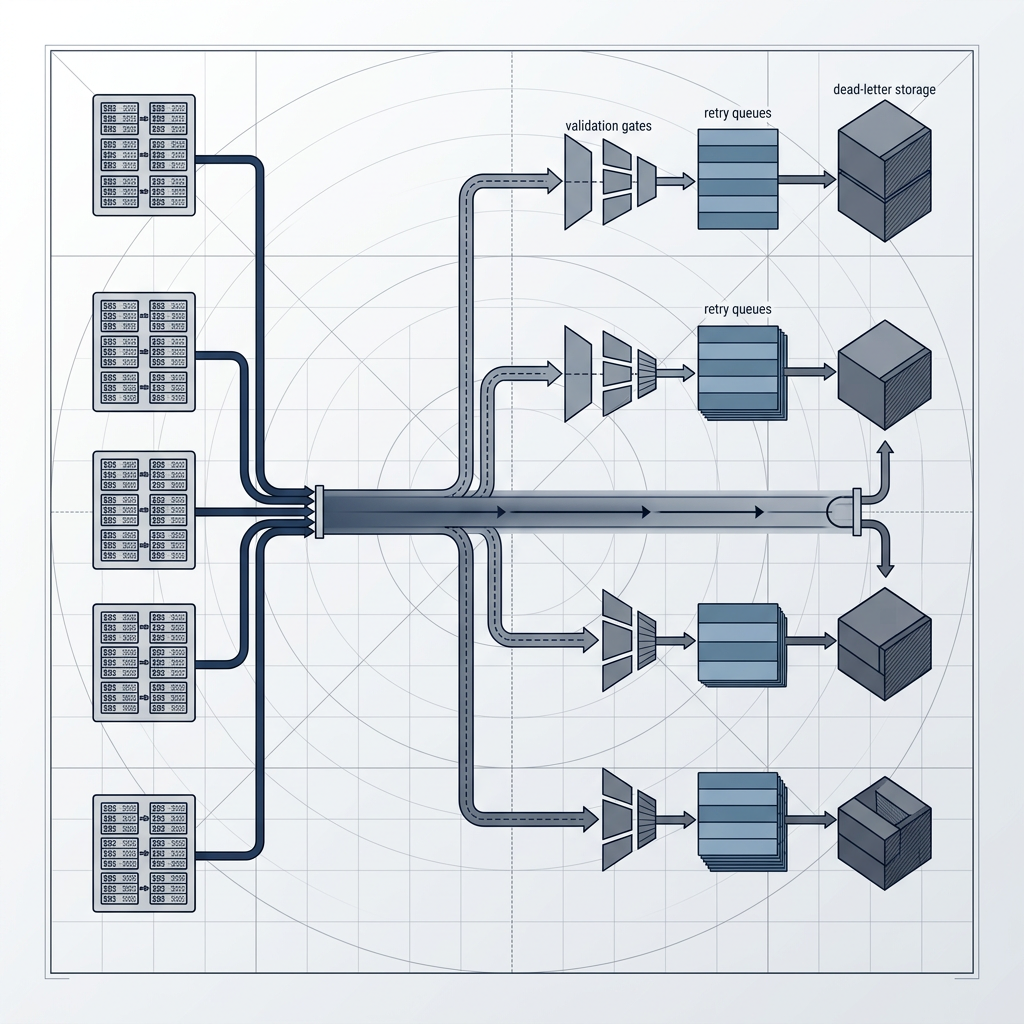
Schema validation is where most teams either do nothing (accepting any payload shape and dealing with garbage in the warehouse) or go overboard with rigid schemas that break every time a product ships a new feature. The practical middle ground is a schema registry approach where each event_name maps to a versioned JSON Schema. Your /v1/track endpoint validates incoming payloads against the registered schema in real time and returns a 422 with a descriptive error when validation fails. This catches problems at the point of emission rather than three days later when an analyst discovers null revenue values in the warehouse. Teams scaling beyond a handful of events should invest in event taxonomy governance processes that keep schemas current without creating bottlenecks for developers shipping new tracking calls.
Building Resilient Ingestion and Delivery
A correct schema means nothing if events vanish between your API gateway and their destination. The second half of server-side event tracking design is about durability: ensuring that every validated event survives network partitions, consumer downtime, and traffic spikes without loss or duplication.
Retry Logic, Dead-Letter Queues, and Idempotency
The single most common failure mode in production tracking pipelines is not malformed data; it is transient failures (a 503 from your warehouse, a Kafka broker rebalancing, a cold-start Lambda timing out) where events simply disappear because nobody built retry logic. Your API should acknowledge receipt immediately by writing the event to a durable queue (SQS, Kafka, or Pub/Sub) before attempting any downstream delivery. This decouples ingestion from processing and guarantees that a temporary outage in Mixpanel or Snowflake does not mean lost data.
Retries need exponential backoff with jitter to avoid thundering herd problems. After a configurable number of attempts (typically 3 to 5), failed events should route to a dead-letter queue where engineers can inspect, fix, and replay them. Without a DLQ, you are flying blind. You will not even know events were lost until someone asks why last Tuesday's conversion numbers look off. Pair this with the idempotency_key from your payload contract. Every consumer in the pipeline should check this key before processing, which is the only reliable way to prevent double-counted events when retries succeed after a timeout that the producer interpreted as a failure. For a deeper look at server-side tracking internals, including queue selection and consumer group design, that context is essential for teams operating at scale.
REST vs. Webhooks: Choosing the Right Pattern
Most server-side data collection implementations default to a synchronous REST endpoint, and for primary event ingestion, that is usually the right call. Your application code fires a POST to /v1/track, receives a 202 Accepted, and moves on. The API handles validation synchronously and queues the event for async processing. This pattern is simple, well-understood, and easy to load-test.
Webhooks enter the picture when you need to push events to third-party consumers or when external systems (like payment processors or CRM platforms) need to send events into your pipeline. The critical difference is delivery guarantees. A REST call from your own code is retryable by the caller. A webhook delivery to an external system requires your infrastructure to own the retry responsibility, which means you need outbound retry queues, signature verification, and a first-party data infrastructure that logs every delivery attempt. When comparing server-side tracking tools, evaluate whether a vendor handles outbound webhook retries natively or pushes that complexity onto your team.

Vendor Approaches and Production Failure Modes
No API design discussion is complete without examining how existing platforms handle these challenges and where their approaches break down in practice. Comparing Segment server-side tracking, PostHog, and Mixpanel reveals distinct tradeoffs that data engineers should evaluate against their own reliability requirements.
How Segment, PostHog, and Mixpanel Handle Ingestion
Segment's Track API accepts a standardized payload and fans out events to configured destinations, handling retries internally with at-least-once delivery semantics. This works well until a destination has an extended outage. Segment will retry, but its retry window is finite, and events that exhaust retries are not always surfaced clearly. PostHog takes a different approach with its capture endpoint, optimizing for self-hosted deployments where you control the entire pipeline, including the queue, the worker, and the ClickHouse destination. This gives teams full visibility into data quality at every stage but shifts operational burden onto your infrastructure team. Mixpanel's /import endpoint offers the tightest schema enforcement out of the box, rejecting events that do not match expected property types, which catches problems early but can frustrate teams that iterate quickly on event shapes.
The common failure mode across all three is not the vendor's fault: it is teams treating the vendor SDK as the entire tracking strategy. When your application calls analytics.track() without local buffering or error handling, a network blip between your server and the vendor means a lost event. The architecture mistakes that cause the most damage are almost always at the boundary between your code and the vendor's API, not inside the vendor's pipeline.
Monitoring and Debugging in Production
A server-side tracking framework is only as reliable as your ability to detect when it is failing. The minimum viable monitoring setup includes three things: an event volume anomaly alert (if hourly event count drops more than 20% compared to the same hour last week, something is broken), a schema validation failure rate dashboard (a spike means a bad deploy shipped malformed tracking calls), and a DLQ depth metric that pages on-call when it exceeds a threshold. These three signals catch the vast majority of production tracking issues before they corrupt downstream analytics.
Debugging specific events requires correlation IDs that trace an event from the application code that emitted it, through the API gateway, into the queue, and out to every destination. Without this, engineers are reduced to grepping logs across multiple services, trying to figure out why a particular user's purchase event never reached the warehouse. Common tracking mistakes in SaaS often stem from this lack of observability rather than from incorrect tracking code. TrackRaptor covers these operational patterns in depth across its server-side tracking guide series, which is worth reviewing alongside any custom implementation effort.
Conclusion
Designing a server-side tracking API that does not lose data requires deliberate choices at every layer: a strict event schema with validation at the ingestion boundary, durable queuing that decouples receipt from processing, retry logic paired with dead-letter queues for graceful failure handling, and idempotency keys that prevent duplication. These are not optional enhancements; they are the baseline for any team that treats behavioral data as a critical system input. Whether you are building from scratch or auditing an existing pipeline built on Segment or PostHog, the checklist is the same: validate early, queue immediately, retry with backoff, monitor relentlessly, and never trust that a 200 from a downstream service means the event actually landed.
Explore TrackRaptor for deep-dive guides on building production-grade tracking infrastructure that scales with your SaaS product.
Frequently Asked Questions (FAQs)
What infrastructure do you need for server-side tracking?
At minimum, you need an API gateway or HTTP endpoint for ingestion, a durable message queue (such as Kafka, SQS, or Pub/Sub) for buffering, a worker service for processing and routing events to destinations, and a dead-letter queue for handling failures.
How do data engineers validate server-side tracking accuracy?
Data engineers validate accuracy by comparing expected event counts from application logs against actual events landed in the warehouse, using correlation IDs and schema validation failure rates to identify discrepancies at each pipeline stage.
Can you use server-side tracking without client-side tracking?
Yes, many SaaS teams run exclusively on server-side collection for transactional and backend events, though client-side tracking is still useful for capturing UI interactions like clicks, scroll depth, and page views that the server cannot observe directly.
What data loss does server-side tracking prevent?
Server-side tracking prevents data loss caused by ad blockers, browser privacy restrictions, client-side JavaScript errors, and network timeouts that silently drop events before they ever leave the user's device.
Is Segment better than PostHog for server-side tracking?
Segment offers simpler multi-destination fan-out with managed retries, while PostHog provides full pipeline control and self-hosting options, so the better choice depends on whether your team prioritizes operational simplicity or infrastructure ownership.